
How Dethernety is built
A nine-minute technical tour: the graph at the bottom, one API on top of it, and the modules and clients that plug in.
dether.net
The video loads from YouTube when you press play.
Our new nine-minute video explains the design of Dethernety, for security architects, AppSec leads and platform engineers who want to see how it works before trying it.
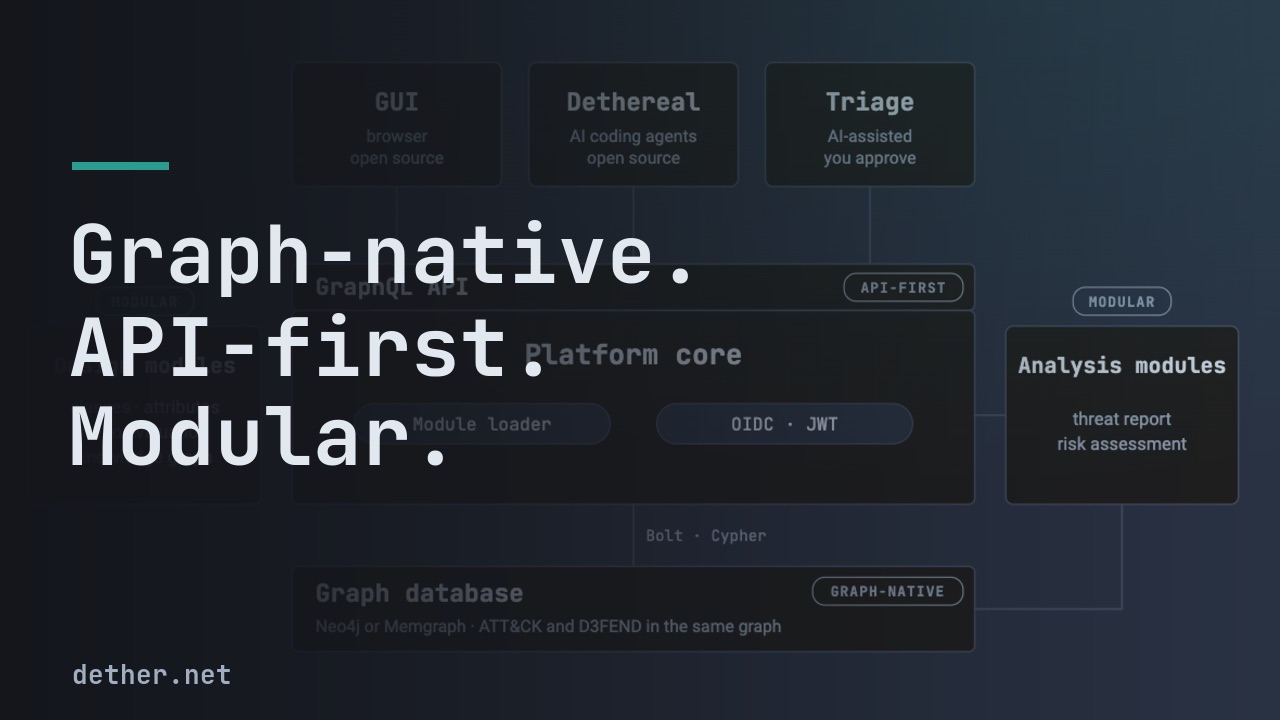
Everything sits on a graph database. Components, trust boundaries, data flows, controls and exposures are stored as nodes in Neo4j or Memgraph. MITRE ATT&CK and D3FEND, the public catalogs of attack techniques and defenses, are loaded into the same graph, so an exposure can point directly at a technique.
The browser editor and the AI clients all call one GraphQL API, and each request carries a sign-in token that the core checks.
Almost everything the platform knows arrives as a module. A design module adds classes: the questions about an element, a guide for checking each answer, and the policies that turn answers into exposures and countermeasures. Analyses, such as the threat report and risk assessment, are modules too.
Three clients sit on top. The browser GUI draws and reviews models, Dethereal works inside AI coding agents, and Triage helps review findings.
Policies, reports and risk assessment run without AI. AI features only propose changes, and a person or a deterministic check accepts them.
The platform, the GUI, Dethereal, the threat report and a general-purpose module library are open source under AGPL-3.0.
dether.net
More articles
BYODt is available
BYODt (Bring Your Own Dethernety): host the platform yourself and get module packages served from our cloud. From EUR 25 per package per month.
November 4, 2026
Threat modeling agentic architectures: two new videos
A seven-minute video and a 90-second short on threat modeling AI agents, using a fictional support copilot.
October 16, 2026