
Data Protection: a personal data map from your threat model
A new analysis gives the data protection office a personal data map and Art. 30 RoPA input, built from the threat model the security team already keeps. It comes with every module package.
dether.net
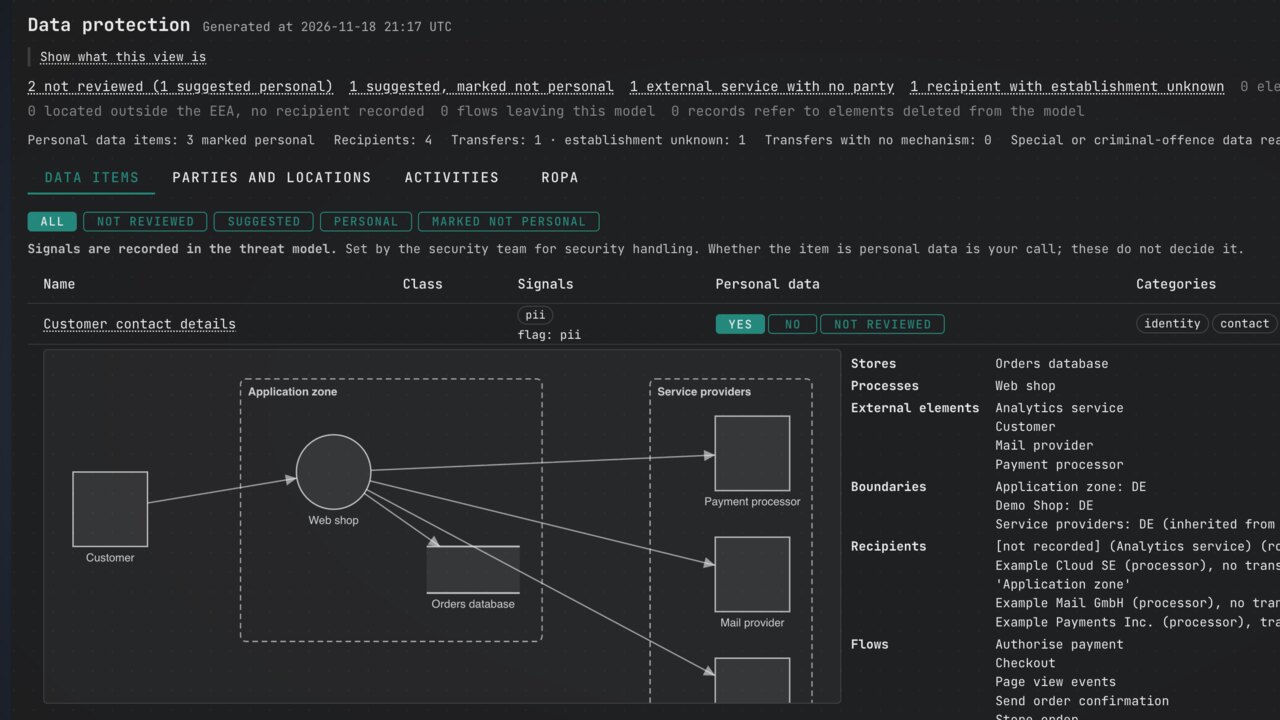
A threat model already records most of what a data protection office asks about: the data items, the components that store and process them, the flows that carry them and the boundaries they sit in. Data Protection 0.1.0 is a new analysis that puts that record to work for the office. It comes with every module package.
The office doesn't edit the threat model. It works in its own view of the model and adds what only it knows: which data items are personal, who the parties are and where they are established, and what each processing activity is for. There is no second inventory to build. The module puts the two together and shows:
- which data items are personal, with their data categories, data subjects and whether they are special category or criminal offence data;
- where each personal item is held, processed and sent, and the boundaries it sits in with their country;
- every party it reaches, and whether that is a transfer outside the EEA, judged by where the party is legally established;
- the processing activities with your organisation's record, as Art. 30 RoPA input;
- a completeness list of what the model doesn't say yet, such as an activity with no retention or a recipient with no recorded establishment, each with the GDPR article it bears on.
Three exports come out of it: a personal data map and the RoPA input as HTML reports with your installation's brand, and the RoPA as a CSV file for your RoPA tool.
How it works
Add a Data Protection analysis to a model and open it. There is nothing to run: the view is worked out from the model and the office's records each time it opens, so when the security team changes the architecture, the map follows. The work goes in four tabs, in the order it is done: data items, parties and locations, activities, and the RoPA.
The module suggests which items look personal, from the regulatory flags and credential flag the security team set and from the item's data class. A suggestion never marks anything. An item stays not reviewed until someone in the office answers.
The analysis is deterministic. There is no AI, nothing is sent off your platform, and the same model and records always give the same result.
What it is not
It is evidence for the office, not a legal or compliance assessment. It never says that processing is lawful or that a record is complete, and it prints lawful basis, retention and transfer mechanism details as you entered them. It describes the system processing that is modelled, so it is as good as the model, and the known limits are worth reading before you rely on a result.
This first release has no privacy risk register, DPIA screening, Art. 32 evidence section or check for personal data in logs. It needs platform 0.17.0 or later.
The Data Protection page shows the view, and the guide walks through each tab and export.
dether.net
More articles
Dethereal 0.6.0: triage is built in
Triage of the platform's findings now runs inside Dethereal, on Claude Code, Codex and OpenCode. The separate Dethereal Triage plugin is retired.
November 16, 2026
SalesBleed, threat modeled
A five-minute video: how a public web form could leak Agentforce data, modeled in Dethernety, and what one fix changes.
November 13, 2026